


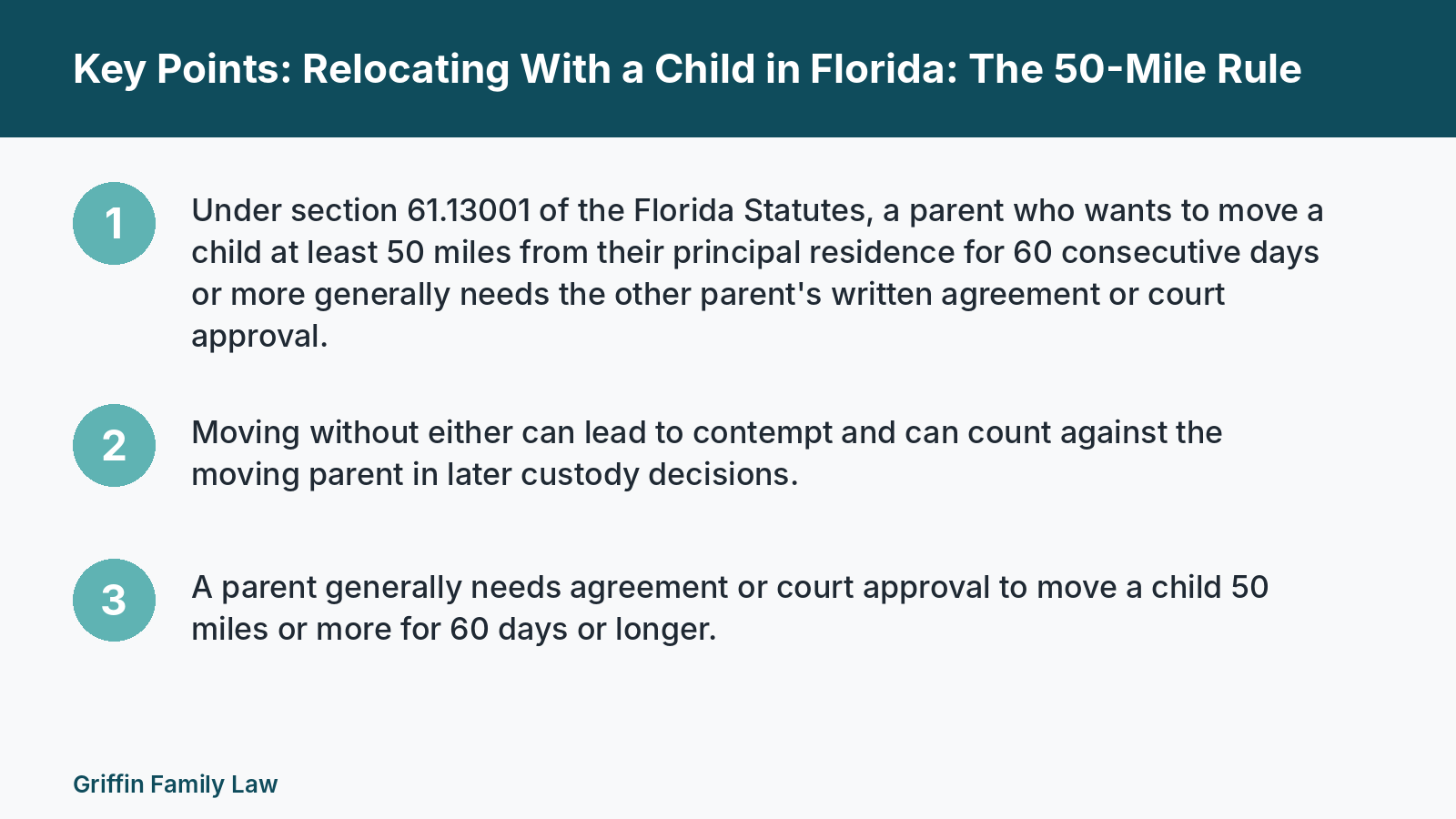
Under section 61.13001 of the Florida Statutes, a parent who wants to move a child at least 50 miles from their principal residence for 60 consecutive days or more generally needs the other parent’s written agreement or court approval. Moving without either can lead to contempt and can count against the moving parent in later custody decisions.
Reviewed by Kent Griffin, attorney at Griffin Family Law. Last reviewed November 2026.
Job changes, family support, and military orders often lead parents to consider moving. In Northeast Florida, many families connected to NAS Jacksonville and Naval Station Mayport regularly face relocation questions. Florida has a detailed relocation statute that applies whenever a move would take a child far enough to affect the parenting plan.
Here is how the 50-mile rule works and what parents should do before moving.
What Counts as Relocation
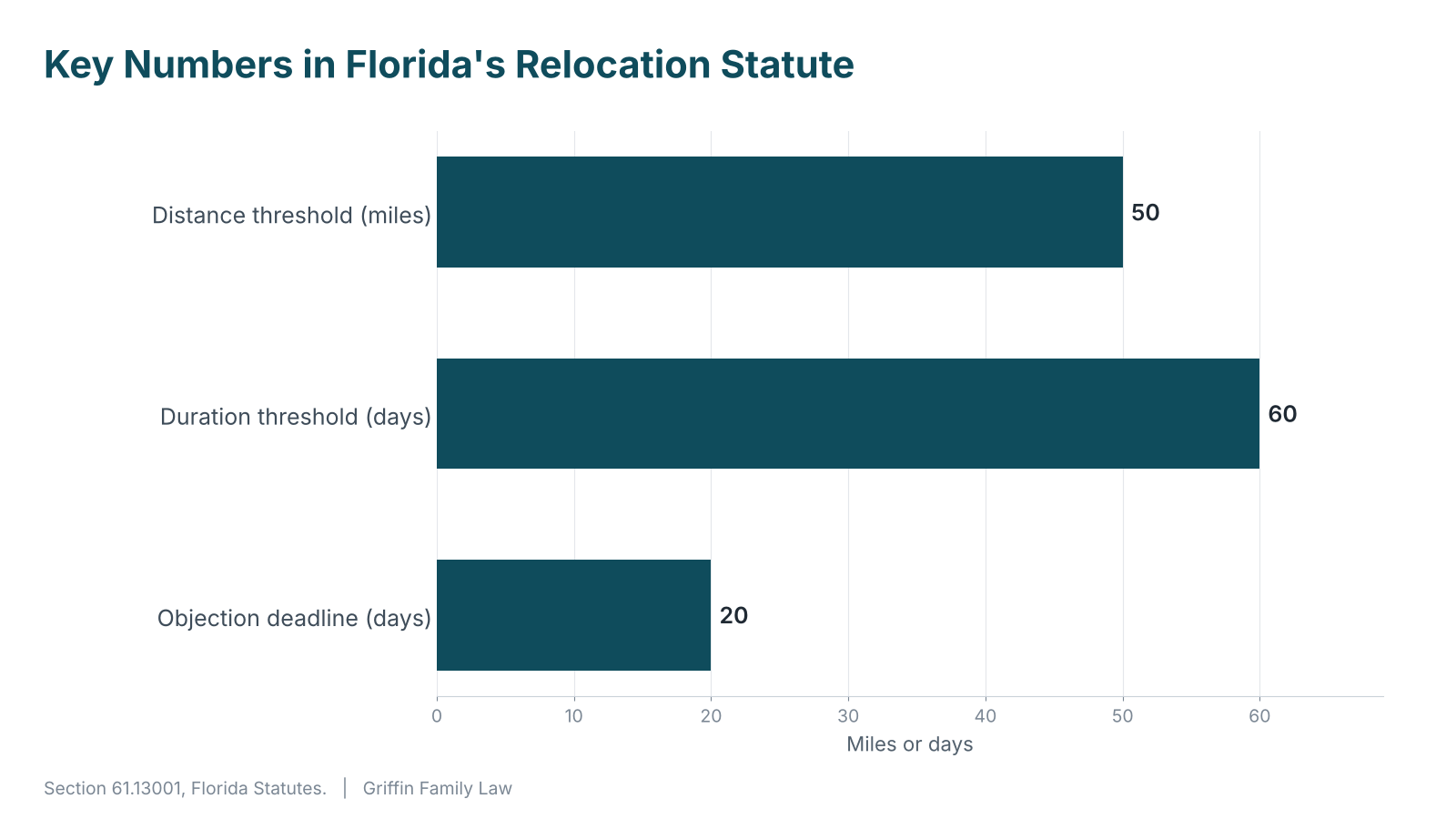
Relocation means a change in the location of the principal residence of a parent from the residence at the time of the last order establishing or modifying time-sharing, or at the time of filing the pending action. The move must be at least 50 miles away and last at least 60 consecutive days. Temporary absences for vacation, education, or health care do not count.
Option 1: Written Agreement
If both parents agree to the move, they can sign a written agreement that:
- States the parents consent to the relocation
- Defines a new time-sharing schedule for the non-relocating parent
- Describes transportation arrangements for time-sharing
If there is a pending case or existing order, the agreement should be filed with the court for approval. Learn more about parenting plans and time-sharing in Florida.
Option 2: Petition to Relocate
If the other parent does not agree, the relocating parent must file a petition to relocate and serve it on the other parent. The petition must include:
- A description of the new residence, including address and phone number if known
- The date of the intended move
- A detailed reason for the move, including any job offer in writing
- A proposed revised time-sharing schedule and transportation plan
- A required statement warning that an objection must be filed within 20 days
The 20-Day Objection Deadline
The other parent has 20 days after service to file a written, sworn objection. If no timely objection is filed, the relocation is presumed to be in the child’s best interest, and the court may approve it without an evidentiary hearing. If an objection is filed, the court schedules a hearing.
How Courts Decide Contested Relocation
There is no presumption for or against relocation. The court considers many factors, including:
- The nature and quality of the child’s relationship with each parent and siblings
- The child’s age, developmental stage, and needs
- The feasibility of preserving the relationship with the non-relocating parent
- The child’s preference, considering age and maturity
- Whether the move will improve the quality of life for the parent and child
- The reasons each parent seeks or opposes the move
- Any history of substance abuse or domestic violence
The relocating parent has the initial burden to show the move is in the child’s best interest.
Military Families and Relocation
Military orders often require moves on short notice. Florida law gives special consideration to service members, and courts generally may not permanently modify time-sharing based solely on a deployment or temporary assignment. When the service member is the one relocating, or when a civilian parent wants to follow a new duty station, careful planning and early filings help. Learn more about Jacksonville child custody and time-sharing.
What Happens If You Move Without Permission
Relocating without written agreement or court approval can expose a parent to contempt and an order to return the child. The court may also consider it when deciding relocation and any future time-sharing issues.
Planning a Relocation
- Talk with the other parent early about a possible agreement.
- Gather job offers, school information, and housing details.
- Draft a realistic long-distance time-sharing schedule.
- Budget for travel costs and decide who pays.
- File well before the intended move date.
Frequently Asked Questions
What is the 50-mile rule in Florida custody?
A parent generally needs agreement or court approval to move a child 50 miles or more for 60 days or longer.
How long does the other parent have to object to relocation?
20 days after being served with the petition.
What happens if no objection is filed?
The relocation is presumed to be in the child’s best interest.
Does the 50-mile rule apply to temporary moves?
No. Temporary absences for vacation, education, or health care are excluded.
Can a military parent’s deployment change time-sharing permanently?
Florida law generally prohibits permanent changes based solely on deployment.
What if I relocate without permission?
You may face contempt and an order to return the child.
What is section 61.13001 of the Florida Statutes?
It is Florida’s parental relocation statute. It defines relocation as a move of at least 50 miles for at least 60 consecutive days and sets the agreement, petition, and objection process.
Does Florida presume equal time-sharing?
Yes. Since July 1, 2023, Florida law presumes that equal time-sharing is in a child’s best interests, though the presumption can be overcome with evidence.
Talk to a Florida Relocation Attorney
Griffin Family Law helps parents in Neptune Beach, Jacksonville, and across Northeast Florida seek or oppose relocation, including military families at NAS Jax and Mayport. When you call, our team will ask about the proposed move, your current parenting plan, and your children’s needs, then explain your options.