


A Jacksonville high-asset divorce lawyer helps protect business interests, real estate, investments, retirement accounts, and income during a divorce. These cases often involve asset valuation, hidden asset concerns, alimony disputes, and complex property division. Griffin Family Law helps clients in Jacksonville protect their financial future with focused legal guidance.
The Role of a Jacksonville High Asset Divorce Lawyer
A high asset divorce can affect your home, business, savings, retirement, investments, and long-term financial security. When valuable property is involved, every detail matters. A Jacksonville high asset divorce lawyer can help you understand what is at stake before you agree to anything.
High-asset divorce cases in Jacksonville often involve more than one bank account or a family home. Many include business ownership, rental property, investment accounts, retirement plans, bonuses, professional practices, stock options, or inherited assets. Some cases also involve hidden income, disputed values, or one spouse having more control over the financial records.
Griffin Family Law helps clients in Jacksonville handle complex divorce matters with a clear plan. The goal is to protect your rights, identify the full financial picture, and help you make informed decisions during a stressful time.
Assets That Need Careful Review In A High Asset Divorce
A high net worth divorce attorney in Jacksonville may need to review several types of property and financial records, including:
- Marital homes and vacation homes
- Rental properties and real estate investments
- Business ownership interests
- Professional practices
- Retirement accounts and pensions
- Brokerage and investment accounts
- Stock options, bonuses, and deferred compensation
- Valuable personal property
- Marital debt and business debt
- Possible hidden or undervalued assets
Suggested Chart: Common Assets In A High Asset Divorce
Common assets that need careful review in a high asset divorce:
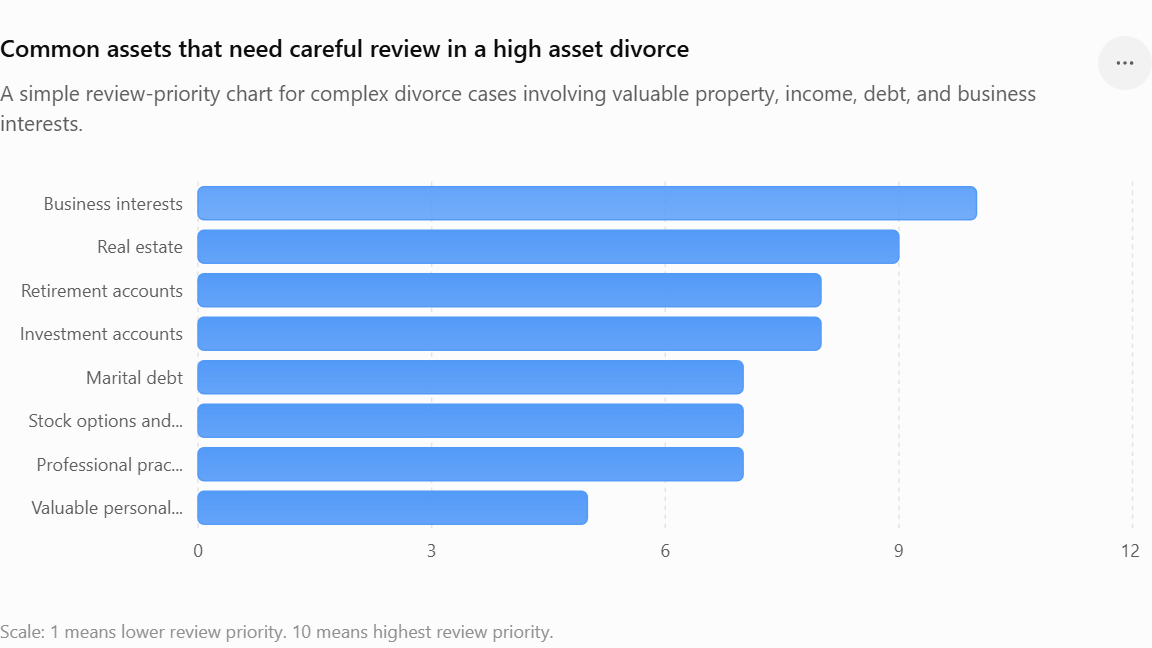
This chart shows common asset categories that often require closer review in a high-asset divorce. Business interests, real estate, retirement accounts, and investments often require careful documentation before property division decisions are made.
Why Early Legal Guidance Matters
In a complex property division case, waiting too long can create problems. Financial records can become harder to gather. Assets can be moved, sold, undervalued, or mixed with other accounts. A rushed settlement can also leave you with less protection than you expected.
A high asset divorce lawyer in Jacksonville can help you slow the process down, ask the right financial questions, and review the details before you sign an agreement. That matters when your future, your business, your retirement, or your children’s financial stability is involved.
If you are facing a high-asset divorce in Jacksonville, Griffin Family Law can help you take the next step with greater clarity and control.
What Counts As A High Asset Divorce In Florida?
A high-asset divorce is not defined by a single dollar amount. In many cases, the issue is the type of property involved, how much financial review is needed, and how hard it is to divide everything fairly.
A divorce may become more complex when one or both spouses own valuable property, business interests, investment accounts, retirement savings, or income-producing assets. These cases often require a closer look at what is marital property, what may be separate property, and what each asset is worth.
A Jacksonville high-asset divorce lawyer can help review financial details before property division, alimony, or settlement decisions are made. This matters because some assets may look simple on paper but carry tax issues, debt, uncertain future income, or a disputed value.
A high asset divorce in Jacksonville may involve:
- A family business or professional practice
- Multiple homes or rental properties
- Retirement accounts, pensions, or deferred compensation
- Brokerage accounts, stocks, or investment portfolios
- Executive bonuses or stock options
- Inherited money mixed with marital funds
- Valuable vehicles, jewelry, art, or collectibles
- Business debt or real estate debt
- Hidden, transferred, or undervalued assets
The more layers of finance a divorce involves, the more important it becomes to slow down and review the full picture. A quick agreement may seem easier at first, but it can create long-term financial problems if an asset is overlooked, misvalued, or divided without understanding the full impact.
Financial Areas That Often Need Close Review
An illustrative planning chart for high asset divorce cases. It shows common financial areas that may need careful review before settlement.
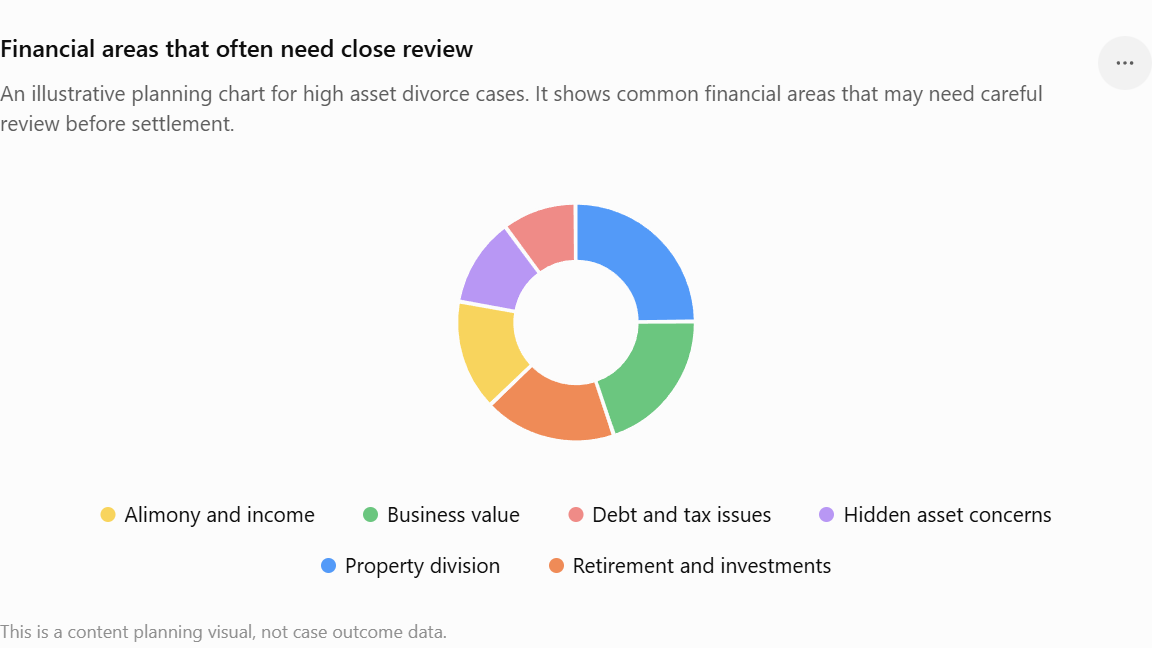
This chart shows common financial areas that may require close review during a high-asset divorce. Property division, business valuation, retirement accounts, income, debt, and hidden asset concerns can all affect the final outcome.
Protecting Businesses And Professional Practices During Divorce
Business ownership often makes a high asset divorce more complex. A company, medical practice, law practice, real estate business, or family-owned operation may have value beyond the money in its bank account. The business may also provide income, benefits, retirement contributions, vehicles, paid expenses, or future growth.
A Jacksonville high-asset divorce lawyer helps review the business as part of the overall financial picture. This review may include ownership records, tax returns, profit and loss statements, payroll records, debt, cash flow, and the role each spouse played in the business.
Business value can be one of the most contested aspects of a divorce. One spouse may believe the business is worth more. The other may argue that the value is lower due to debt, market changes, operating costs, or personal goodwill. In some cases, the business owner’s income also affects alimony, child support, and settlement negotiations.
Important business issues to review include:
- Who legally owns the business
- When the business started
- Whether the business grew during the marriage
- How much income the business produces
- Whether personal expenses run through the company
- Whether the business has debt
- Whether one spouse worked in the business without equal pay
- Whether the business depends on one spouse’s personal reputation
- Whether a buyout, offset, or structured settlement makes sense
A high-net-worth divorce attorney in Jacksonville may also help determine whether outside financial experts are needed. Business appraisers, accountants, or valuation professionals may help review records and explain the company’s value.
Business Valuation Review Table
| Business issue | Why it matters in divorce |
| Ownership records | Shows who owns the business and when ownership began |
| Tax returns | Helps show reported income, deductions, and business performance |
| Profit and loss statements | Shows whether the business is growing, shrinking, or staying steady |
| Business debt | Affects the true value of the company |
| Cash flow | Helps separate business value from income available for support |
| Personal goodwill | Matters when the business depends on one spouse’s name, skill, or reputation |
| Personal expenses | May show income or benefits not listed as wages |
| Spouse involvement | Helps show whether both spouses helped build or support the business |
High asset divorce cases involving a business should not be rushed. A quick agreement may overlook business value, company debt, tax issues, or income that affects support. Careful review helps protect the business, the financial future of both spouses, and the long-term stability of the final divorce agreement.
Dividing Real Estate, Investments, And Retirement Accounts
Real estate, investments, and retirement accounts can create major disputes in a high asset divorce. These assets may look easy to divide, but the true value is often more complicated. Market changes, taxes, loans, penalties, and account rules can all affect what each spouse receives.
A Jacksonville high asset divorce lawyer can help review these assets before settlement talks begin. This review can help show what is marital property, what may be separate property, and whether an asset has gained value during the marriage.
Common assets that may need review include:
- The marital home
- Vacation homes
- Rental properties
- Land or commercial property
- Brokerage accounts
- Stocks and bonds
- Retirement accounts
- Pensions
- Deferred compensation
- Stock options
- Cryptocurrency or digital assets
- Real estate debt
- Investment account loans
Real estate can be hard to divide because it often includes more than the sale price. A home may have equity, a mortgage, tax issues, repair costs, or emotional value. Rental property may also generate income, incur expenses, result in depreciation, and create debt.
Investment and retirement accounts need careful review because the account balance does not always show the full picture. Some accounts have tax consequences. Some require special court orders before division. Others may include gains, losses, penalties, or future benefits.
A high-net-worth divorce attorney in Jacksonville can help protect your financial interests by reviewing the details before you agree to a division plan. The right plan should look at current value, long-term value, debt, taxes, and future financial stability.
Asset Review Table
| Asset type | What needs to be reviewed |
| Marital home | Equity, mortgage, title, repairs, sale options, buyout options |
| Rental property | Income, expenses, leases, debt, property value |
| Vacation home | Ownership, use, equity, tax issues, possible sale |
| Brokerage accounts | Current value, gains, losses, tax impact |
| Retirement accounts | Marital portion, account rules, penalties, court order needs |
| Pensions | Present value, future payout, survivor benefits |
| Stock options | Vesting schedule, employer rules, future value |
| Digital assets | Access, ownership, value changes, transfer history |
| Real estate debt | Mortgage balances, liens, credit risk, payment responsibility |
A high asset divorce in Jacksonville should include a full review of both assets and debts. This helps prevent one spouse from keeping the valuable property while the other assumes greater financial risk.
Hidden Assets And Financial Dishonesty In High Asset Divorce
Hidden assets can create serious problems in a high asset divorce. When one spouse controls most of the money, owns a business, manages investments, or handles the family finances, the other spouse may not know what exists or where to look.
A Jacksonville high asset divorce lawyer can help review financial records and look for signs that money, property, income, or business value may not be fully disclosed. This matters because an unfair settlement can happen when one spouse signs an agreement without knowing the full financial picture.
Hidden asset concerns may involve:
- Bank accounts not listed in financial records
- Money transferred to relatives or business partners
- Business income that suddenly drops
- Personal expenses paid through a company
- Delayed bonuses, commissions, or contracts
- Undervalued real estate or business interests
- Cryptocurrency or digital accounts
- Cash withdrawals with no clear purpose
- Fake loans or inflated debt
- Valuable property moved before filing
Financial dishonesty can also appear in small details. A missing statement, a new account, a sudden drop in income, or a change in business records may point to a larger issue. These details need careful review before property division, alimony, or child support decisions are made.
Warning Signs Of Hidden Assets
| Warning sign | Why it matters |
| Missing bank statements | May hide transfers, withdrawals, or new accounts |
| Sudden income drop | May affect alimony, child support, or business value |
| Large cash withdrawals | May show money being moved before settlement |
| New debt | May be used to reduce the marital estate |
| Changed business records | May affect business valuation |
| Transfers to family members | May move money out of reach |
| Delayed bonuses | May reduce reported income during divorce |
| Unusual tax return changes | May show income shifts or new deductions |
A high-net-worth divorce attorney in Jacksonville can help by asking the right questions and gathering the right documents. The goal is not to create conflict. The goal is to ensure that each asset, debt, income source, and financial record receives a proper review before a final agreement is signed.
When hidden assets are a concern, quick settlements can be risky. Careful review can help protect your future and reduce the chance of giving up property or support you may have had a right to claim.
Alimony And Income Issues In High Net Worth Divorce
Alimony can become one of the most contested issues in a high-asset divorce. This is especially true when one spouse earns much more, owns a business, receives bonuses, or controls income through a company.
A Jacksonville high-asset divorce lawyer helps review income from every source, not just a paycheck. In many high-net-worth divorce cases, income includes salary, business distributions, bonuses, commissions, rental income, investment income, deferred compensation, or personal expenses paid through a business.
The court may also review the lifestyle during the marriage, each spouse’s financial need, each spouse’s ability to pay, and the length of the marriage. These details matter because support decisions should reflect the full financial picture.
Income issues that often need review include:
- Salary and wages
- Business income
- Partnership distributions
- Bonuses and commissions
- Rental income
- Investment income
- Deferred compensation
- Stock options
- Personal expenses paid by a business
- Sudden income changes before or during divorce
A high-net-worth divorce attorney in Jacksonville may also review whether one spouse is underreporting income or reducing income on paper. This concern often comes up when a spouse owns a business, works in sales, receives irregular payments, or has control over company records.
Income Review Table
| Income issue | Why it matters |
| Business income | Helps show money available for support |
| Bonuses | May affect income even when payment is not monthly |
| Rental income | May show extra cash flow from property |
| Investment income | May affect need, ability to pay, or property division |
| Deferred compensation | May have value even if payment comes later |
| Stock options | May create future income or marital value |
| Company-paid expenses | May show benefits not listed as wages |
| Sudden income drop | May raise questions about timing or accuracy |
Alimony in a high asset divorce should not be based on guesses. Careful income review helps protect both sides from an unfair support agreement. It also helps make sure settlement talks start with accurate financial information.
High Asset Divorce With Children Involved
Children add another layer to a high asset divorce. Parents may need to work through time-sharing, child support, school costs, health care, travel, and daily routines while also dividing major financial assets.
A Jacksonville high-asset divorce lawyer helps parents consider both the legal and financial aspects of the case. The goal is to protect the children’s stability while ensuring that support and parenting decisions reflect the full financial picture.
High asset divorce cases involving children may include extra financial details, such as:
- Private school tuition
- Tutoring or academic support
- Health insurance
- Uncovered medical costs
- Sports and travel teams
- Summer camps
- Child care or nanny expenses
- College savings accounts
- Travel between homes
- Special needs care
- Extracurricular activities
- Parent work schedules
Child support may also become more complex when one parent earns a high income, owns a business, receives bonuses, or has income that changes throughout the year. A high-net-worth divorce attorney in Jacksonville may review wages, business income, investment income, rental income, and other financial resources before calculating support.
Parenting plans also need careful attention. A clear plan may reduce conflict over school schedules, holidays, vacations, transportation, medical decisions, and communication. This matters when parents have demanding careers, business travel, military obligations, or homes in different areas.
Child-Related Financial Planning Table
| Child-related issue | Why it matters |
| Private school | Tuition, fees, books, uniforms, and payment responsibility need review |
| Health care | Insurance, uncovered costs, therapy, and dental care may affect support |
| Sports and activities | Travel teams, lessons, equipment, and fees may create added expenses |
| Child care | Work schedules, nanny costs, after-school care, and summer care may need planning |
| Travel | Transportation between homes, out-of-state trips, and vacation schedules may create conflict |
| College savings | Existing accounts and future contributions may need clear terms |
| Special needs care | Medical, educational, and daily support costs may require extra planning |
A high-asset divorce should not treat children’s expenses as an afterthought. Clear planning helps reduce future disputes and gives both parents a better understanding of their financial responsibilities.
Why Local Jacksonville Experience Matters In A High Asset Divorce
High asset divorce cases often involve local details that matter. A Jacksonville family may own property in Duval County, run a local business, work in a professional practice, or have children in area schools. These details can affect how the case is prepared, valued, negotiated, and resolved.
A Jacksonville high-asset divorce lawyer understands how local family law matters move through the local court system. In Duval County, family law matters may involve divorce, child support, modifications, paternity, parenting plans, and time-sharing issues. Local court resources are handled through the Fourth Judicial Circuit and the Duval County Clerk.
Local experience can help with issues such as:
- Jacksonville real estate values
- Business interests tied to the local market
- Professional practices serving Northeast Florida
- Military families connected to nearby bases
- Parenting plans involving Duval County schools
- Rental properties in Jacksonville or the beaches
- High-income households with complex records
- Privacy concerns during a stressful divorce
- Local filing and court process expectations
A high-net-worth divorce attorney in Jacksonville can also help clients stay organized from the start. This may include gathering property records, business records, tax returns, retirement statements, investment statements, and proof of income before settlement talks begin.
High asset divorce cases often require more planning than standard divorce cases. When local property, business income, court procedure, and parenting issues overlap, the details can affect the final agreement. Working with a local lawyer helps keep the case focused, organized, and tied to the financial facts that matter most.
How Griffin Family Law Helps With High Asset Divorce Cases
A high-asset divorce requires a clear plan from the start. Griffin Family Law helps clients in Jacksonville review the financial issues, understand their legal options, and make decisions with more confidence.
These cases often involve more than one concern at a time. A business may affect income. Real estate may affect debt. Retirement accounts may affect long-term security. Alimony, child support, and property division may all connect to the same financial records.
Griffin Family Law can help with high asset divorce issues such as:
- Reviewing marital and separate property
- Identifying assets and debts
- Looking for missing or incomplete financial records
- Reviewing business ownership interests
- Addressing real estate and investment accounts
- Preparing for property division talks
- Reviewing income for alimony or child support
- Helping clients prepare for mediation
- Protecting parental rights when children are involved
- Preparing for court when an agreement cannot be reached
A Jacksonville high asset divorce lawyer can also help clients avoid rushed decisions. This matters when a settlement involves a business, a retirement account, rental property, an investment portfolio, or a valuable home. Once an agreement is signed, it may be hard to fix mistakes later.
High Asset Divorce Process Timeline
| Step | What happens |
| Consultation | Review the main concerns, assets, debts, income, and family issues |
| Financial review | Gather bank records, tax returns, business records, account statements, and property records |
| Asset identification | Separate marital assets, possible separate assets, debts, and disputed property |
| Valuation | Review the value of businesses, real estate, investments, retirement accounts, and other property |
| Strategy planning | Decide what needs protection, what needs negotiation, and what issues may require court |
| Negotiation or mediation | Work toward a fair agreement when possible |
| Court preparation | Prepare evidence, records, and arguments if the case cannot settle |
| Final agreement or ruling | Resolve property division, support, parenting issues, and other divorce terms |
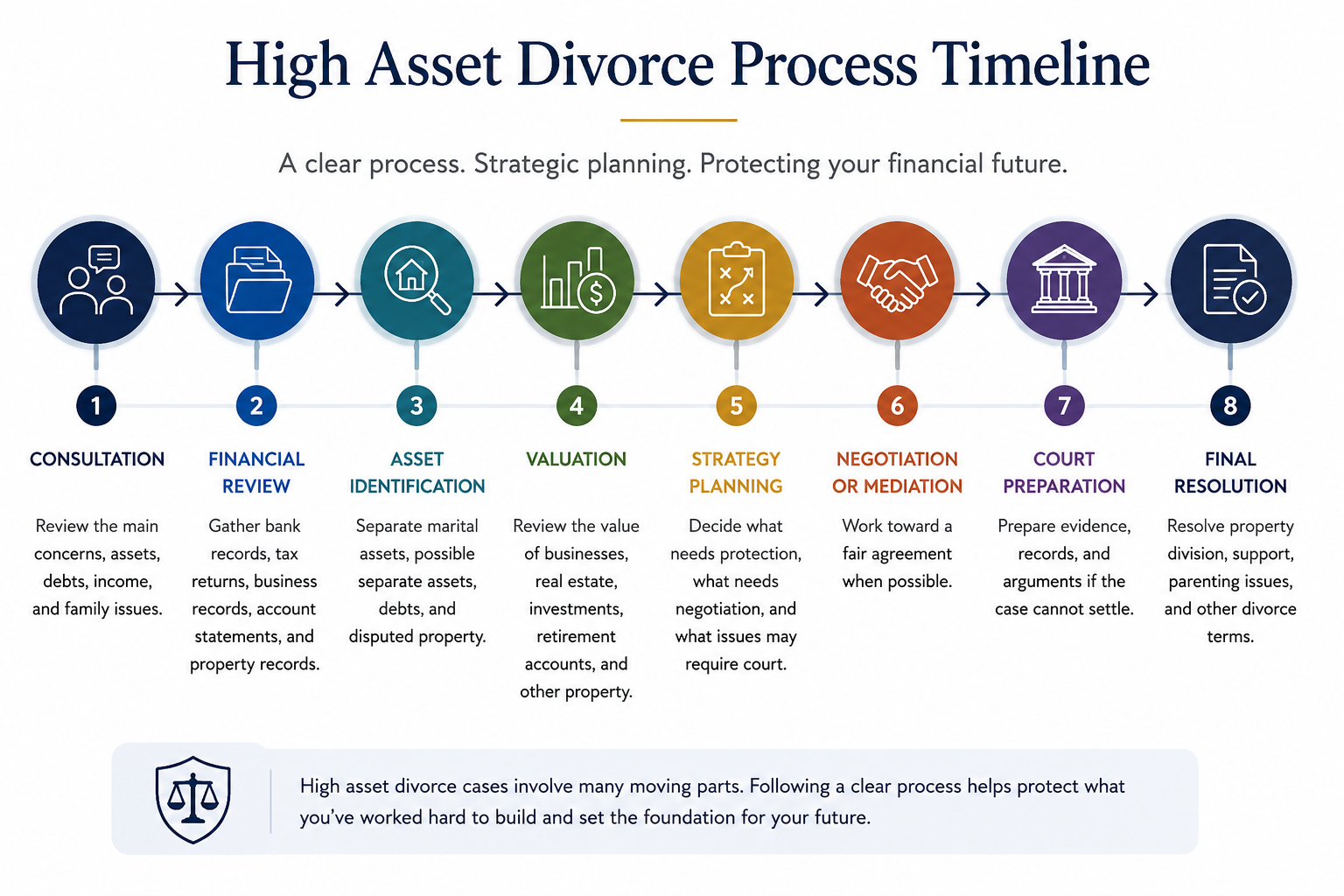
High asset divorce cases are often stressful because the outcome can affect your future for years. Griffin Family Law helps clients stay organized, ask the right questions, and protect what matters most before making major decisions.
Common Mistakes To Avoid In A High Asset Divorce
High asset divorce cases involve more financial risk than a basic divorce. One missed account, one rushed agreement, or one unclear business value can affect your future for years.
A Jacksonville high-asset divorce lawyer helps clients slow down, review the records, and avoid making decisions based on stress or pressure. This matters when the case involves real estate, business ownership, retirement accounts, investments, alimony, or child support.
Common mistakes to avoid include:
- Signing a settlement before all assets are reviewed
- Assuming the business value is accurate
- Ignoring tax issues tied to property or investments
- Moving money without legal guidance
- Hiding assets or leaving out financial records
- Trusting verbal promises from a spouse
- Forgetting about retirement accounts or pensions
- Overlooking business debt or real estate debt
- Letting emotions control settlement decisions
- Posting about the divorce online
- Failing to gather records early
- Agreeing to alimony without a full income review
A high-net-worth divorce attorney in Jacksonville helps review financial details before major decisions are made. This includes property records, bank statements, investment statements, business records, tax returns, retirement accounts, debts, and sources of income.
Mistake And Risk Table
| Common mistake | Possible risk |
| Rushing a settlement | Important assets or debts might be missed |
| Ignoring business value | One spouse might receive less than they should |
| Overlooking tax impact | The real value of an asset might be lower than expected |
| Hiding assets | Credibility and case strategy may be damaged |
| Moving money during divorce | The court may question the reason for the transfer |
| Trusting verbal promises | The final agreement may not protect what was discussed |
| Ignoring retirement accounts | Long-term financial security may be affected |
| Poor recordkeeping | Asset claims may become harder to prove |
High asset divorce in Jacksonville should be handled with patience and planning. A careful approach helps protect your property, your income, your children, and your long-term financial stability.
Talk To A Jacksonville High Asset Divorce Lawyer
A high asset divorce can affect the property, income, business interests, and retirement savings you worked hard to build. Before signing an agreement, it is important to understand what is being divided, what is being valued, and what financial risks need attention.
Griffin Family Law helps clients in Jacksonville handle high asset divorce cases with clear guidance and focused legal support. Whether your case involves complex property division in Jacksonville, hidden assets, business ownership, real estate, retirement accounts, or alimony, the right legal plan can help protect your future.
If you are facing a high asset divorce in Jacksonville, contact Griffin Family Law today.
Call 904-344-5093 to schedule a consultation.
Frequently Asked Questions About High Asset Divorce In Jacksonville
What makes a divorce a high asset divorce in Jacksonville?
A high-asset divorce usually involves valuable property, complex finances, or assets that require a deeper review. This may include business ownership, real estate, retirement accounts, investment accounts, high income, stock options, or concerns about hidden assets.
How are businesses handled in a Florida divorce?
A business may need to be included in the marital estate if it was started, owned, grown, or supported during the marriage. The review may include business records, income, debt, ownership, goodwill, and the company’s value.
What happens if my spouse is hiding assets?
Hidden asset concerns need careful review before settlement. A Jacksonville high-asset divorce lawyer can help identify missing records, unusual transfers, sudden income changes, business record issues, or property that was not disclosed.
Are retirement accounts divided in a high asset divorce?
Retirement accounts may be reviewed during property division if they include marital funds or growth during the marriage. These accounts often need careful handling because taxes, penalties, account rules, and court orders can affect the final division.
Does high income affect alimony in Florida?
High income can affect alimony because support issues often involve income, need, ability to pay, and the lifestyle during the marriage. Business income, bonuses, investment income, rental income, and deferred compensation may all need to be reviewed.
Should I talk to a lawyer before signing a settlement agreement?
Yes. A settlement agreement can affect your home, business, savings, retirement, support, and parenting terms. Speaking with a high-net-worth divorce attorney in Jacksonville before signing helps you understand the risks and protect your financial future.
What financial records should I gather before a high asset divorce?
Useful records often include tax returns, bank statements, retirement statements, investment account records, business documents, real estate records, mortgage statements, loan records, pay stubs, bonus information, and insurance documents. These records help show the full financial picture.
Why does property valuation matter in a high-asset divorce?
Valuation matters because the amount assigned to a business, home, investment, or retirement account affects the final settlement. An incorrect value can lead to an unfair division of assets or debt.